Laser Safety in Live Events and Production
Laser systems create extraordinary visual impact — but they are not stage lighting. They concentrate coherent radiation into beams that can permanently damage eyesight in fractions of a second. Here's what every producer, operator, and venue needs to know.
Why Laser Safety Is Non-Negotiable
A single Class 4 laser beam can cause irreversible retinal burns before your blink reflex kicks in. We're talking about exposure times under 0.25 seconds. There is no surgery, no corrective procedure, and no recovery from a direct hit to the fovea. The damage is permanent.
Unlike conventional lighting, laser light does not diverge significantly over distance. A beam that's 3mm wide at the aperture can still be 3mm wide at 200 metres. This means the hazard zone is not limited to the stage — it extends to the back wall, the balcony, the aircraft overhead, and anything reflective in between.
Every live event laser installation requires a formal risk assessment, an appointed Laser Safety Officer (LSO), and documented operating procedures. No exceptions. If your laser vendor tells you otherwise, find a different vendor.
Key principle: Audience scanning — projecting beams directly into a crowd — is the highest-risk laser application in the events industry. It is prohibited outright in several jurisdictions and requires rigorous engineering controls, safety calculations, and regulatory approval everywhere else.
Laser Classification: Know What You're Working With
The international classification system (IEC 60825-1) groups lasers by their potential to cause harm. In the live events space, you'll primarily encounter Class 3B and Class 4 systems. Both are hazardous. The distinction matters because it determines your safety protocols, required documentation, and in many countries, your legal obligations.
ClassPowerRisk LevelEvent UseClass 1 / 1M Extremely low Safe under normal useConsumer devices, barcode scannersClass 2 / 2M< 1 mW Eye-safe if exposure is briefLaser pointers, alignment toolsClass 3R1–5 mW Low risk, direct viewing hazardSmall display installationsClass 3B5–500 mW Immediate eye hazard from direct or reflected beamsMid-scale shows, corporate eventsClass 4> 500 mW Eye and skin hazard; fire riskLarge-scale concerts, festivals, outdoor
Class 4 lasers used in major live events typically operate between 5W and 40W of output power — sometimes significantly more for outdoor installations. At these power levels, both direct and diffusely reflected beams are hazardous. Skin burns are possible. Combustible materials in the beam path can ignite.
The Role of the Laser Safety Officer
A qualified Laser Safety Officer is not optional — it's the foundation of every compliant laser operation. The LSO is responsible for conducting the hazard analysis, defining safety zones, establishing control measures, and ensuring that every person in the production team understands the protocols.
Core LSO Responsibilities
- Hazard evaluation. Calculate the Nominal Ocular Hazard Distance (NOHD) and Maximum Permissible Exposure (MPE) for every laser system in the rig. These calculations determine the minimum safe distance between beam path and audience.
- Zone establishment. Define the Laser Controlled Area and ensure physical barriers, signage, and interlock systems prevent unauthorised entry into hazard zones during operation.
- Beam path control. Verify that all beam terminations are accounted for. Every beam must either terminate on an opaque, non-reflective surface or be directed into free airspace above audience head height with adequate safety margin.
- Documentation. Maintain written Standard Operating Procedures, risk assessments, equipment specifications, and incident reports. In regulated jurisdictions, this documentation must be available for inspection.
- Emergency procedures. Define and rehearse shutdown protocols. Every operator must be able to kill all laser output instantly via hardware E-stop — not software, not DMX blackout.
Critical Safety Controls
Hardware E-Stop
Every laser installation must have a hardwired emergency stop that cuts power to the laser source directly. This is non-negotiable. Software-based shutoffs — including DMX blackout commands — are not acceptable as primary safety controls. Software fails. Hardware E-stops do not, provided they are wired correctly and tested before every show.
Beam Termination
No beam should exit the venue or performance space without intentional, controlled termination. For outdoor events, beams directed skyward must comply with aviation authority notification requirements. In most countries, laser operators are legally required to notify air traffic control when projecting beams above the horizon within a defined radius of airports and flight paths.
Reflective Surfaces
Mirrors, polished metal, glass, water features, gloss-painted surfaces, sequinned costumes, metallic confetti, and even smartphone screens can redirect laser beams unpredictably. A specular reflection off a moving truss element or a performer's watch can send a Class 4 beam directly into the audience. The LSO must identify and control every reflective surface within and adjacent to the beam path.
Audience Scanning: The Hard Rules
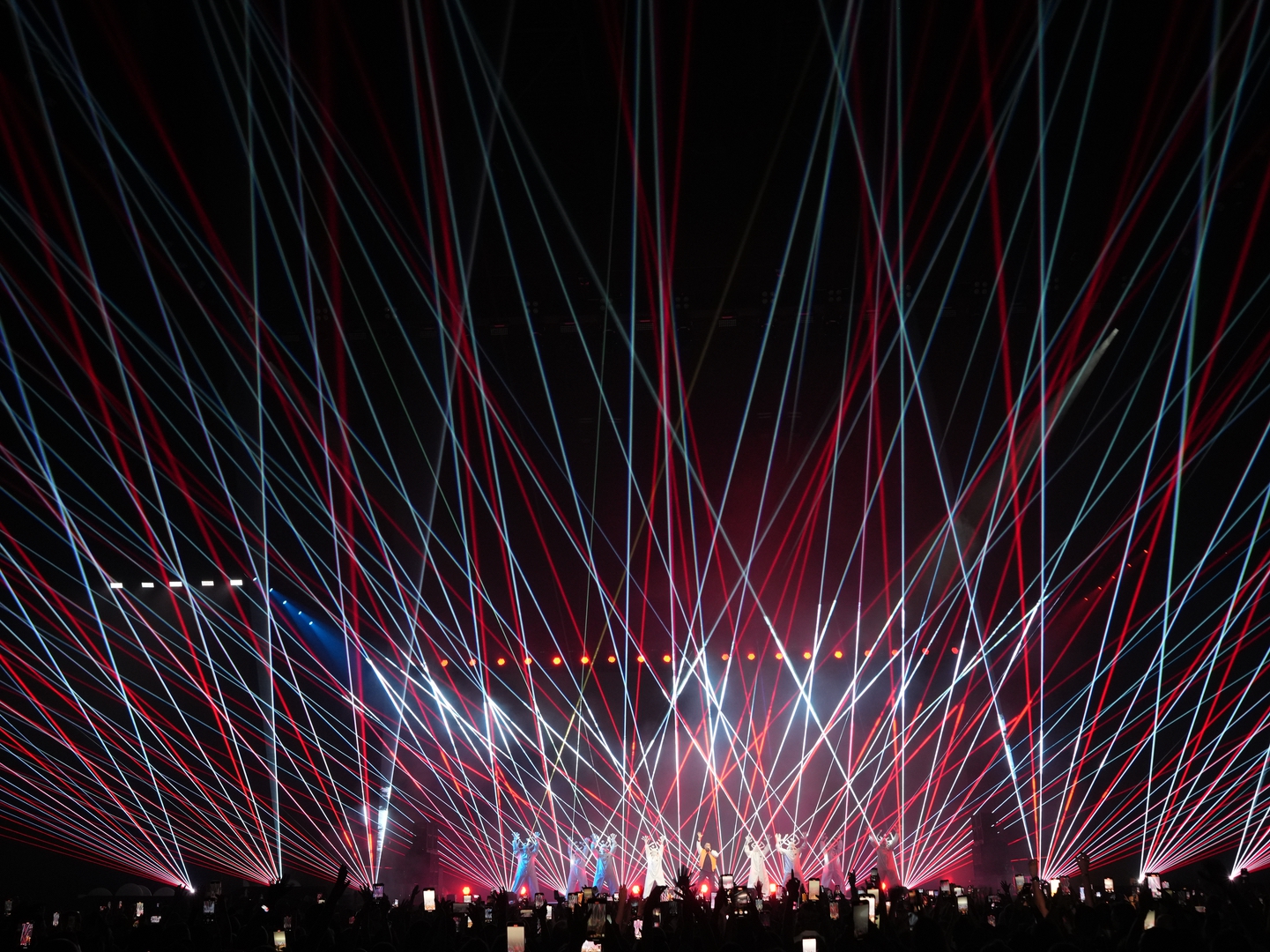
Audience scanning — also called direct audience exposure — is the practice of projecting laser effects directly into the crowd, creating immersive visual experiences where beams visibly pass through or over the audience area. It's visually spectacular. It's also the single most regulated application in the laser display industry.
For audience scanning to be legally and safely performed, every beam that could reach an audience member must be below the Maximum Permissible Exposure limit at the point of contact. This is a function of beam power, divergence, scan speed, wavelength, and distance. The calculations are not trivial. Getting them wrong means exposing people to harmful radiation levels.
Industry reality check: A significant number of laser shows at festivals and nightclubs worldwide operate audience scanning effects without proper MPE calculations, without a qualified LSO, and without scan-fail safety systems. This is not a grey area. It is a regulatory violation and a genuine hazard. The fact that injuries are underreported does not mean they don't occur.
Requirements for Compliant Audience Scanning
- MPE verification. Every audience-facing effect must be measured and calculated to confirm exposure levels remain below applicable MPE limits across all wavelengths in use.
- Minimum scan speed. Static beams or slow-scanning effects that dwell on any point longer than the MPE time base are prohibited. Effect programming must enforce minimum scan velocities.
- Safety margin. Professional practice demands a safety factor of at least 3× below MPE limits to account for environmental variables, equipment degradation, and measurement uncertainty.
- Real-time monitoring. Power output must be monitored during the show. Laser sources degrade, thermal management affects output, and power fluctuations can push exposure above safe limits.
Regulatory Landscape
Laser safety regulations vary significantly by jurisdiction. Some countries require formal variance applications and government approval for every public laser display. Others have minimal oversight. The absence of regulation does not mean the absence of risk — it means the operator bears full liability when something goes wrong.
In the United States, the FDA's Center for Devices and Radiological Health (CDRH) regulates laser products and requires variance approval for laser light shows involving audience exposure. In the UK, HSE guidance (HSG95) provides the regulatory framework. The EU references EN 60825-1 and national implementations. In the Gulf region, regulations are evolving, but international safety standards — particularly IEC 60825-1 and the ILDA safety guidelines — represent the accepted baseline for professional operations.
Regardless of local regulation, any professional laser operator should be working to IEC 60825-1 and ILDA standards at minimum. Compliance with these frameworks is not just about avoiding fines — it's about demonstrating professional competence and protecting the people in the room.
Personal Protective Equipment
Laser safety eyewear is wavelength-specific. A pair of goggles rated for 532nm green lasers provides zero protection against 445nm blue or 638nm red beams. Multi-wavelength shows require multi-wavelength rated eyewear, and the optical density (OD) rating must be matched to the power levels in use.
PPE is a last line of defence, not a primary control. If your safety plan depends on people wearing the right goggles at the right time, your safety plan has a structural problem. Engineering controls — beam path design, interlocks, E-stops, scan-fail systems — must eliminate the hazard before PPE enters the conversation.
Common Failures That Cause Incidents
- No LSO on site. The operator "knows what they're doing" but has no formal qualification, no written risk assessment, and no documented procedures. This is the most common failure mode in the industry.
- Uncontrolled reflections. A last-minute scenic change introduces a mirror-finish surface nobody accounted for. The beam hits it during the show and redirects into the audience.
- Software-only shutdown. The E-stop button triggers a DMX command instead of cutting hardware power. The network glitches. The laser stays on.
- Audience scanning without calculations. The visual looks great in rehearsal, but nobody ran the MPE numbers. Exposure levels are 10× above safe limits.
- No scan-fail protection. A galvo stalls mid-show. A 20W beam locks onto a single point in the audience for 1.2 seconds before anyone reacts.
- Aviation non-compliance. Beams projected skyward without notifying air traffic control. A pilot reports a laser strike. The operator faces criminal charges.
Building a Safety Culture
Compliance is the floor, not the ceiling. The best laser operators in the industry don't treat safety as a checkbox — they treat it as a professional discipline. They invest in training. They document everything. They walk the venue before every show looking for hazards. They say "no" to clients who push for effects that compromise safety margins.
If you're producing an event and your laser vendor cannot produce a written risk assessment, cannot name their LSO, cannot show you scan-fail safety documentation, or cannot explain their MPE calculations in plain language — you have your answer. Walk away.
Laser technology creates some of the most powerful visual experiences in live events. That power demands respect, competence, and rigorous safety practice. Every time.
This article is provided as general industry guidance. It does not constitute legal or regulatory advice. Always consult local regulations and a qualified Laser Safety Officer for your specific application.